.webp)
Vending vs Micromarket: Is Healthy Vending Enough for Your Workplace?

You’ve got a vending machine, and you want to make your breakroom better. Naturally, “healthy vending” feels like the next step: swap in better-for-you snacks, add a few improved drink options, call it an upgrade.
And to be fair, that does help, but only to a point.
Eventually, it stops being about what’s inside the machine and starts being about something bigger: what kind of breakroom experience are you trying to create? Because there’s a real difference between improving a machine and building a breakroom your team wants to use.
Upgrading a vending machine makes an appliance better. A micromarket changes how people use and experience the space altogether. Here’s a more honest way to think through which one fits your workplace.
Quick Answer: The main difference between traditional healthy vending and a micromarket is flexibility and variety. Healthy vending offers a limited selection of shelf-stable snacks through a machine. A micromarket operates like an open, self-serve mini-store, providing fresh meals, craft beverages, flexible layouts, and real-time inventory tracking.
Quick Why: CBRE research found 90% of employer occupiers say on-site food and beverage when choosing office locations, and that nearly three-quarters of employees cite connection and community as their primary reason to be on site. If you’re not prioritizing an inviting third space with amenities employees need, you’re probably behind your competitors.
Vending vs micromarket: what’s the real difference?
At a glance, both options give employees quick access to snacks and drinks. But the experience is altogether different.
- Traditional Vending is straightforward and functional. You can absolutely stock healthier options, but you’re still working within a fixed number of slots, limited product sizes, and slower rotation. Once it’s set, it’s mostly set.
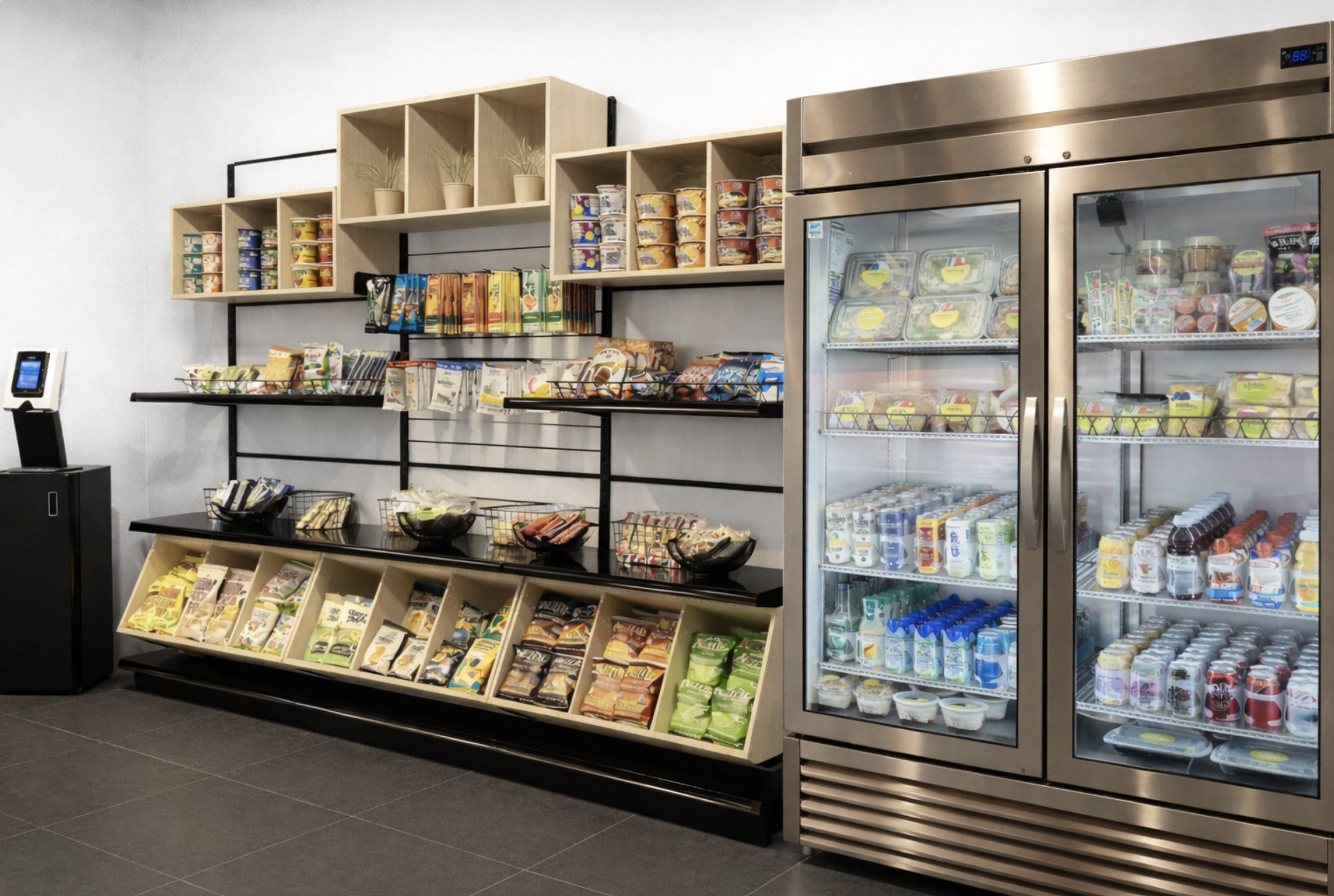
- Micromarkets feel more like a small, self-serve store. Open shelving, coolers, and self-checkout make room for fresh meals, grab-and-go options, cold brew, kombucha, and even local products. Behind the scenes, inventory tracking shows what’s moving so you’re not guessing or stuck with stale products.
It’s why the self-serve model is taking off nationwide. According to Grand View Research, the micro market industry is projected to grow to over $10 billion by 2030 as businesses move away from restrictive, traditional vending setups.
When healthy vending hits a wall
Swapping chips for protein bars helps, but standard machines fall short on fresh items.
A vending machine only has so many slots. Fresh, high-protein, or locally sourced items rarely fit, and short shelf-lives lead to high spoilage in a rigid delivery system. Once you’ve swapped out a few items, you’re still left with a setup that feels static and uninspiring.
When your team asks for better food options, the bottleneck usually isn't the snack list. It's the machine itself.
Does vending still make sense?
The short answer is yes, but in specific situations:
- Smaller or low-traffic spaces where variety isn’t a priority.
- Basic access locations where the only goal is to offer a quick soda or standard snack.
But don’t assume a vending machine is the only option for a tight layout. Micromarkets can be designed to fit surprisingly compact areas while still offering a much broader selection.
.webp)
Navigating a realistic budget
For most organizations, the biggest hesitation around micromarkets is cost. And that’s fair.
But it helps to look at the big picture, budget options, and how they operate over time:
- Funding Models: Some organizations fully subsidize the market as an employee perk, while others use a shared-cost or pay-per-item model to keep it self-sustaining.
- Long-Term Value: Better data and smarter inventory management minimizes waste while supporting employee engagement and workplace culture.
When it's set up correctly, it’s a more efficient office snack investment.
How to decide what’s right for your workplace
Instead of focusing on "healthy vs. unhealthy", let’s consider scale and long-term goals:
- How many people use the space daily?
- Are you providing basic utility, or building a space that encourages employees to stay on-site, connect, and refuel?
- How important are fresh lunches, local brands, and rotating healthy snack options to your culture?
If your current vending machine sits largely ignored or used as a last resort, it’s usually a sign you’ve outgrown it. A micromarket doesn’t just upgrade what’s available. It changes how your breakroom works, turning it into a space people actually use, not just pass by.
And you don’t have to figure out the right mix or layout alone. At Agora Refreshments, we look beyond the equipment to help you design a breakroom program that suits you and the people who use it.
Let’s explore your office micromarket solution.
Breakroom Inspiration